

Amazon FBA Calculator UK
Work out how much you can realistically make on Amazon based on your capital, ROI, and how aggressively you sell your stock.
📊 Quick Reference Table
Assumes all stock sells within the month — use the calculator above for realistic figures
| Monthly Profit | 10% ROI | 20% ROI | 30% ROI | 40% ROI | 50% ROI |
|---|---|---|---|---|---|
| £500 | £5,000 | £2,500 | £1,667 | £1,250 | £1,000 |
| £1,000 | £10,000 | £5,000 | £3,334 | £2,500 | £2,000 |
| £2,000 | £20,000 | £10,000 | £6,667 | £5,000 | £4,000 |
| £5,000 | £50,000 | £25,000 | £16,667 | £12,500 | £10,000 |
| £10,000 | £100,000 | £50,000 | £33,334 | £25,000 | £20,000 |
| £15,000 | £150,000 | £75,000 | £50,000 | £37,500 | £30,000 |
| £20,000 | £200,000 | £100,000 | £66,667 | £50,000 | £40,000 |
Ready to Start Selling on Amazon UK?
I’ve built a 7-figure Amazon FBA business using Online Arbitrage. Check out my free beginner’s guide to get started.
Read the Beginner’s GuideI speak to people on a daily basis who come to me with completely unrealistic expectations about how much they can make on Amazon FBA. They’ve either been looking at someone like me who is three years into the business and thinking that’s where they’ll be in month one, or they’ve been told by these crazy online gurus and course sellers that they can make insane profits from day one.
I’ve actually even seen a video from an “online guru” who claims in their course — which they sell, obviously — that you can turn £1,500 into £25,000 in six months at 60% ROI per month. And that by month 12 you’d be sitting at £422,000. This is of course absolute nonsense and totally unrealistic, and they should be ashamed of themselves.
Now don’t get me wrong, Amazon FBA is an amazing opportunity and you can make real insane money with this business model, but it takes time and effort before you can hit those £10k profit months.
So I built this free FBA calculator UK tool to give you a realistic picture of what you can actually expect.
This isn’t like Amazon’s own FBA revenue calculator that works out fees on individual products — this is about the bigger picture. How much can your FBA business actually earn you over 12 months based on your capital, your ROI, and how fast you’re shifting stock.
Plug your numbers in, have a play with the settings, and see what’s genuinely achievable based on your capital, your ROI, and how fast you’re turning stock over. No hype, no made-up figures — just maths.
So How Much Can You Make With Amazon FBA?
This is the million pound question, isn’t it? And I know it’s annoying but the honest answer is — it depends.
It basically comes down to three things. How much capital you’ve got to invest in stock, what ROI you’re averaging across your products, and how fast that stock is actually turning over. That’s it. That’s the whole equation really.
Where most people go wrong — and I see this all the time — is they do the maths assuming everything they buy sells straight away. So they think, right, I’ve got 5 grand, I’ll make 30% on it, that’s £1,500 a month. But that’s not how it works. Some of your stock sells in a few days, some takes a month, and some of it just sits there for ages before it shifts. It is what it is. That’s just the reality of selling on Amazon.
That’s why I put the strategy picker in the calculator. Because the speed at which you sell stuff is honestly just as important as your ROI. Probably more important actually.
While I often have the expectation to sell my stock in a month or so, it doesn’t always work that way. I had some items I bought which I expected to sell out within 4-6 weeks. However unfortunately the price tanked on the listing and I decided in this case I was better off waiting 10-12 weeks for the price to recover before I sold the items.
Other times I’ve bought items expecting to have them for a while before selling and they ended up selling within the first day of hitting Amazon.
All you can do is stick to your strategy, follow your buying criteria, do the analysis on the product, and keep learning from past mistakes. Rinse and repeat.
What ROI Should You Be Aiming For?
If you’re new to this — ROI is basically how much profit you make on a product compared to what you paid for it. So if you buy something for a tenner and after Amazon takes all their fees you’re left with £13, that’s 30% ROI. Simple enough.
When you’re starting out, anything between 20 and 30% is good. Don’t let anyone tell you otherwise. I see beginners in the Discord beating themselves up because they’re “only” making 20% ROI and it’s like, mate, you’re making money on Amazon in your first month. That’s amazing. Most people never even get that far. Think about it — most businesses lose money in their entire first year. Some don’t turn a profit for two or three years. And here you are making actual profit in month one. That’s the power of Amazon FBA. You cannot be expected to be running a perfect business from day one.
You will find the odd product that gives you 50%, maybe even 100% on a good day. But don’t expect that to be the norm. If you’re consistently hitting 25-30% across your whole account, you’re doing well. Better than most people actually.
Here’s the thing though. And this is something I bang on about constantly. A product with 50% ROI that takes six months to sell is actually worse than a product with 20% ROI that sells in a week. Because your money is just sat there doing nothing for six months when it could be out there making you more money.
The money is made in the buy, not the sell. But it’s also made in how quickly you can churn that stock.
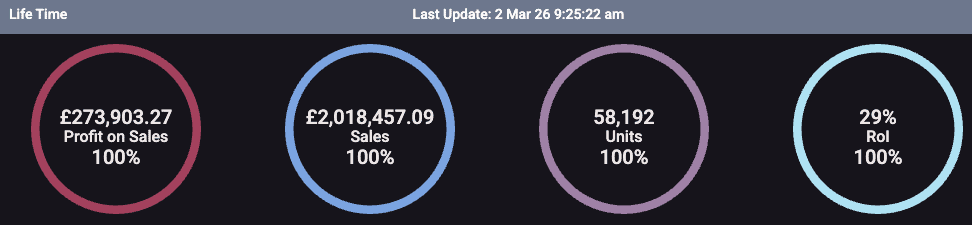
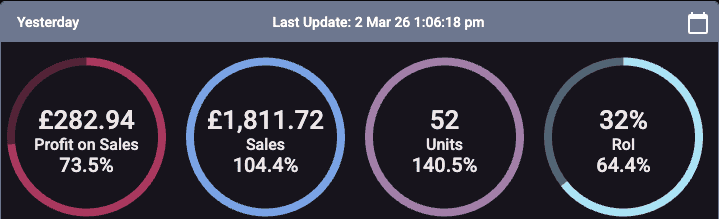
My lifetime ROI across my entire Amazon account is 29%. You can see this below where I’ve actually posted my lifetime profit, revenue, units sold and ROI. No hiding, no cherry-picking my best month — that’s the real number across everything.
Why Sell-Through Speed Matters (Probably More Than ROI)
This is the bit most people completely miss, and to be honest with you it’s probably the most important thing on this whole page.
Your ROI tells you how much you make per product. Fine. But your sell-through speed — basically how fast your stock is actually selling — that’s what determines how much cash is landing in your account each month. They’re two completely different things and people mix them up all the time.
So let’s say you’ve got 10 grand in stock and your average ROI is 30%. If you’re only selling through about a third of your stock each month — which is what I’ve called the Conservative strategy in the calculator — you’re making roughly a grand a month. But if you’re turning over half your stock each month on the Balanced strategy, that jumps to about £1,500. Same capital. Same ROI. Completely different monthly income.
That’s why I put three strategies in there:
Conservative — this is basically where you hold onto stock and wait for the best price. Some of it might sit in Amazon’s warehouse for three, four months. The margins tend to be better when it does sell, but your money is tied up for longer. If you’re patient and you don’t need the income straight away, it works. But it’s slow.
Balanced — this is what I’d tell most people to go for. You’re aiming to get most of your stock sold within a couple of months. If something isn’t moving, you drop the price a bit rather than waiting forever. It’s a decent mix of margin and speed. Not too aggressive, not too slow.
Aggressive — this one’s for people who want to grow fast. You go wide, buy lots of different products, price them competitively, and aim to shift everything within about a month. Your margins per product will be lower, but your capital is constantly cycling back round so you can reinvest it. This is how you scale up quickly if that’s what you’re going for.
I actually used the conservative approach for the longest time. I didn’t have a guide or calculator like this and I think it actually hurt me. Don’t get me wrong, I am happy with how much I’ve made over the years, but I think if I’d taken the aggressive approach I would have made way more money.
I was too fixated on maximising the profit on every deal I got, mainly because if I was only able to get say 10 gaming headsets on a deal and I would never get any more of them, I wanted to maximise my profit on those 10 units.
However I should have been thinking bigger picture — while I may not be able to get 10 more gaming headsets, I could use that money to buy another deal. And there is ALWAYS another deal.
Reinvesting Your Profits — Should You Do It?
If you want to grow? 100% yes.
The reinvest toggle on the calculator shows you the difference between taking your profits out each month versus ploughing them back into more stock. And the compound effect is pretty mental when you actually see it over 12 months.
Like, with £10,000 starting capital on Balanced at 30% ROI — if you reinvest everything, by month 12 your monthly profit is way higher than month 1 because your capital has grown. It adds up fast.
My advice is keep as much profit in the business as possible for the first year or so. Try not to take anything out to pay bills or salary. Most of you out there will be starting this as a side hustle so you can avoid taking money out.
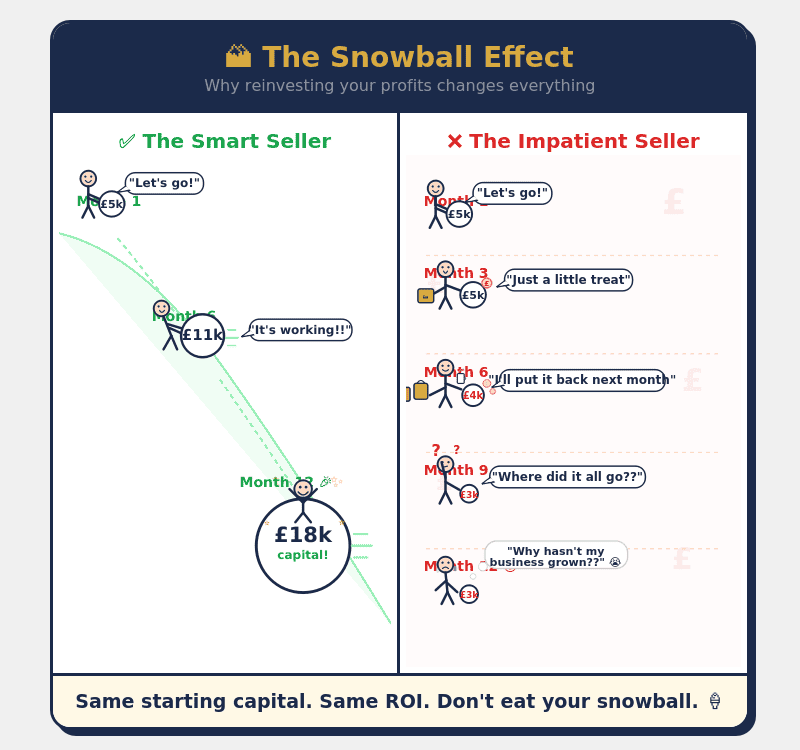
Think of your Amazon business as a snowball. It starts off slowly but as it rolls down the hill it grows and grows. If you stop and start taking chunks out, it’s going to grow much slower and you’ll lose momentum.
How Much Do You Need to Start?
Another one I get asked constantly. And the honest answer is you can start with £1,000-£2,000 if you want. You’re not going to be making life-changing money from it straight away, but it proves the model works and gives you something to build on.
With about £2,000 at 30% ROI on a Balanced strategy, you’re looking at maybe £300 a month profit. Not exactly retire-to-Dubai money. But if you reinvest that, after 6-12 months you’re in a much stronger position.
With £5,000 to £10,000 things start getting more interesting. You’ve got enough to properly spread across different products so you’re not just betting everything on five items and hoping they all sell. Diversification basically. Don’t get me wrong, you’ll still have bad buys — everyone does — but they won’t sink you.
And if you’ve got 25 grand or more to put in, you can start seeing some proper monthly numbers. But you absolutely don’t need that to start. I know people who started with less than a grand and built it up. It just takes longer. You’ve got to start somewhere.
So I started with about £30k, which I totally understand is a huge amount of money. I also made a lot of mistakes along the way, which you can avoid by reading all the articles on my website. I genuinely believe you can start with as little as £1k and grow from there.
I actually speak to so many people who start with 1k to prove the concept, and once they get some sales under their belt, realise this opportunity is real, they end up putting extra money in from their savings, or each month from their paycheque. Essentially this entire business is driven by your capital and how you deploy that into stock.
Tools I Actually Use to Track This Stuff
Right, so the calculator gives you projections and that’s great for planning. But once you’re actually buying and selling, you want proper tools to track what’s really going on in your account.
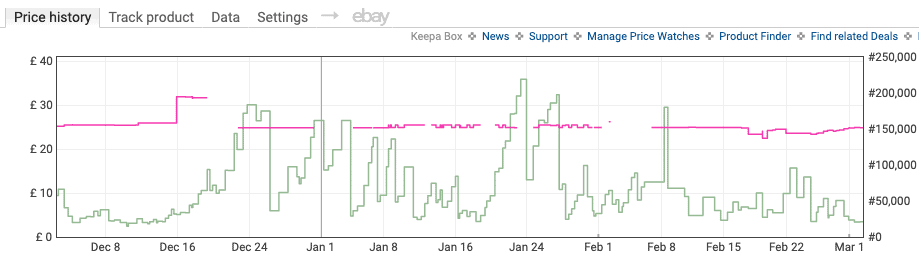
Keepa — honestly if you’re not using Keepa you’re basically just guessing. It shows you the full sales history and price history of any product on Amazon, plus how many other sellers are on the listing. Essential for deciding whether to buy something or not. I’ve written a full Keepa beginner’s guide that walks you through how to actually use it because it can be a bit overwhelming when you first look at it.
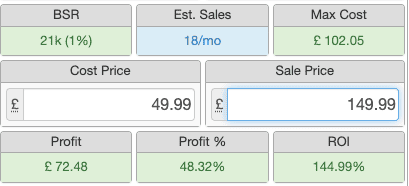
SellerAmp — I use this for quick product analysis when I’m sourcing. Basically you scan a product and it tells you your estimated ROI and profit after all Amazon fees within seconds. Way faster than messing about with spreadsheets.
Seller Toolkit — this is what I use to actually track my profits and manage my account. Seller Central’s own reporting is a bit of a nightmare to be honest, so having a proper dashboard that shows you your real profit and loss, tracks your inventory, and flags any stock that Amazon has lost or damaged is pretty much essential once you’re up and running. It also handles reimbursements — basically finding money Amazon owes you that you’d never spot yourself.
Getting Started With Amazon FBA UK
If you haven’t started selling on Amazon yet and this all sounds interesting, go and read my Complete Beginners Guide to Getting Started on Amazon. It takes you through everything — setting up your seller account, making your first purchase, sending stock into Amazon, all of it.
And if you’ve got questions about any of this, come join the free Discord community. There’s over 2,300 of us in there and it’s completely free. People at every stage from complete beginners who haven’t made their first sale yet to people doing serious numbers every month. It’s a good bunch.
But yeah. Have a play with the calculator, get a realistic idea of what’s possible with your budget, and then go and actually do it. The calculator is just maths — the real learning happens when you start buying products and seeing what sells and what doesn’t. You’ll make mistakes. Everyone does. But at least now you’ve got realistic expectations rather than whatever some YouTuber promised you in a clickbait thumbnail.
Plug your numbers in. See where you could be in 12 months. And then go make it happen.