
When selling on Amazon, one of the most important things you’ll ever manage is your account health. Think of account health as the backbone of your seller account, it’s what determines how trustworthy you look to Amazon, how Amazon view you as a customer and how safe your selling privileges are.
If you want to sell more, win more of the Buy Box, and keep out of trouble with Amazon, you need to maintain strong account health. Sellers with poor account health risk restrictions, suspensions, or even permanent bans. On the other hand, sellers who maintain excellent account health enjoy smoother operations, higher sales, and peace of mind.
In this blog series, we’re going to break down every part of Amazon account health, explain what it means, and give you clear strategies to stay compliant and safe.
The Four Core Parts of Account Health
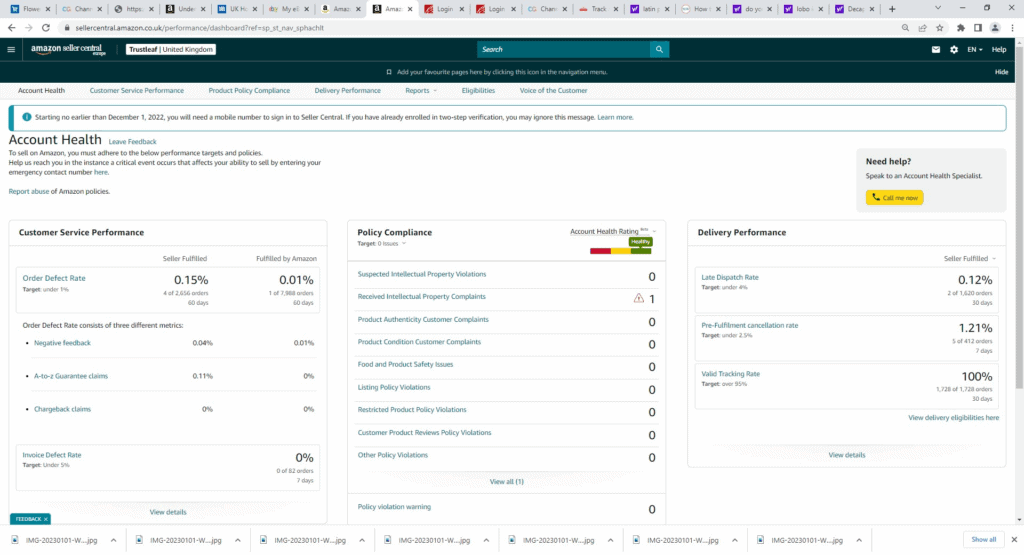
Amazon divides account health into several main sections. Each one has its own rules, metrics, and performance standards that you need to stay on top of. Let’s take a look at the four core areas:
1. Customer Service Performance
This section is all about how well you handle customer experience. Amazon puts the customer first, so your metrics here are critical.
Key metrics include:
- Order Defect Rate (ODR) – Made up of:
- Negative feedback
- A-to-Z Guarantee claims
- Chargeback claims
- Invoice Defect Rate – A measure of how well you provide compliant invoices for your orders.
Keeping these numbers low is essential. High defect rates are one of the fastest ways to get warnings or restrictions.
2. Policy Compliance
Policy compliance is where many sellers run into trouble. This area tracks whether you’re following Amazon’s rules, especially around product quality.
Issues that can appear here include:
- Suspected intellectual property (IP) violations
- Received IP complaints
- Product authenticity complaints
- Product condition complaints
- Food and product safety issues
- Listing policy violations
- Restricted product policy violations
- Customer product review policy violations
- Other policy violations
- Regulatory compliance
Even one violation in this section can have a big impact on your account. We’ll explore how to avoid these in a dedicated blog post.
3. Delivery Performance
Amazon wants customers to receive their orders quickly and reliably. This section measures how well you meet delivery expectations.
Key metrics include:
- Late Dispatch Rate – Orders not shipped by the promised time.
- Pre Fulfillment Cancellation Rate – How often you cancel customer orders before shipping.
- Valid Tracking Rate – Ensuring tracking information is accurate and uploaded on time.
Poor delivery metrics don’t just affect account health, they can also reduce your chances of winning the Buy Box.
4. Manage Your Compliance
This area is all about product compliance requests. Amazon may ask you to provide documentation to prove your products meet certain safety or regulatory standards. Failing to provide these can result in listing removals or account-level action.
Account Health Assurance
Amazon also offers something called Account Health Assurance (AHA). If you maintain an account health score of 250+ for six months, you’ll qualify for this safety net.
With AHA, if anything goes wrong with your account, Amazon will contact you first before taking serious action like suspending your account. It’s an extra layer of protection that gives sellers more security.
Why Account Health Matters
Maintaining strong account health isn’t just about avoiding trouble. It helps you:
- Increase sales by winning the Buy Box more often
- Build trust with customers and Amazon
- Reduce the risk of suspensions or restrictions
- Enjoy smoother, stress-free selling
The better your account health, the stronger your long term business will be.

Final Thoughts
This was just the overview of Amazon Account Health. In the upcoming blogs, I’ll break down each section, Customer Service Performance, Policy Compliance, Delivery Performance, and Compliance all in detail.
We’ll look at:
- The exact rules and metrics you need to follow
- Common mistakes sellers make
- How violations happen
- Proven ways to stay safe and compliant
By the end of this series, you’ll know exactly how to protect your Amazon account and operate like a professional seller.