


Welcome back to the Amazon Account Health Series. In the first post, we introduced account health and why it’s so important to keep your selling privileges safe, maximise sales, and operate sustainably.
In this post, we’re diving into the first pillar of account health which is Customer Service Performance. This part is mainly aimed at your FBM side of your business, as you can see from the image below that the metric measures Seller Fulfilled orders and order fulfilled by Amazon.
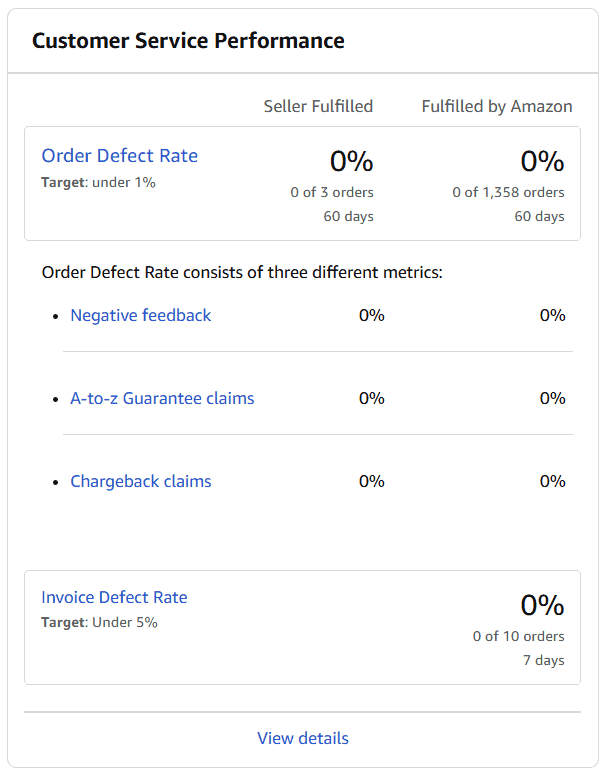
This is a fairly important area of your account because it directly measures how happy your customers are with their experience. Amazon is relentlessly customer focused, that means if a buyer complains or leaves negative feedback with your FBM orders, Amazon will almost always side with the customer. While this can be frustrating, as sellers we need to play by Amazon’s rules and manage our accounts and operations in a way that keeps these metrics under control.
Order Defect Rate (ODR)
Your Order Defect Rate is the key metric that determines how satisfied your customers are. Amazon expects sellers to maintain an ODR below 1%. Anything above this threshold can quickly lead to warnings, restrictions, or suspensions.
The ODR is made up of three parts:
Negative Feedback
- This includes 1 star or 2 star reviews left on your seller profile.
- Even if a complaint is unfair, it still counts against your account unless Amazon agrees to remove it (for example, if it’s product related rather than service related).
A-to-Z Guarantee Claims
- Customers can file these claims if they feel they haven’t received their order on time, if the product is not as described, or if you haven’t resolved their issue.
- Too many claims can sink your ODR quickly. Always respond promptly to customer issues before they escalate to this stage.
Chargeback Claims
- These occur when a customer disputes the payment with their bank or credit card company.
- Chargebacks usually happen if the customer doesn’t recognise the transaction, claims fraud, or believes they didn’t get what they paid for.
- While rare, they’re serious and need to be managed carefully by keeping communication and order tracking transparent.
Invoice Defect Rate
The Invoice Defect Rate (IDR) measures how well you provide invoices to customers, specifically business buyers. If you’re VAT registered, you can set up Amazon’s automated invoice generation, which makes this process seamless. However, if you’re not VAT registered, things become more manual, you must manually provide invoices to any customer who orders through a business account.
To check for these business orders, you can use Seller Toolkit to filter your orders, or Log into your Amazon Seller Central, go to Orders, and filter by Business Orders.
Once identified, you’ll need to generate invoices manually. You can use a free invoice generator like the one i have tagged below. Next, fill in all the required details correctly (customer details, order number, product information, price, etc.) and then Send the invoice directly to the customer through Amazon’s buyer seller messaging system.
https://wise.com/us/invoice-generator
Failing to provide invoices to business customers increases your Invoice Defect Rate and negatively affects your account health!
How to Manage These Metrics
Here are some practical ways to keep your Customer Service Performance healthy:
- Stay proactive with communication – Answer messages quickly and resolve problems before they escalate.
- Monitor orders daily – Keep an eye on late shipments, cancellations, and business orders needing invoices.
- Ensure that you are delivering your FBM orders as soon as possible, especially within the window.
- Pack and package your FBM orders correctly to avoid damage and complaints.
- Always keep tracking information and receipts to prove postage.
- Handle negative feedback – Politely request feedback removal from Amazon if it’s product-related or doesn’t comply with Amazon’s rules.

Final Thoughts
When it comes to account health, ignoring Amazons policies will cost you. The smarter option is to stay vigilant, especially when doing FBM fulfilment. Monitor your metrics daily, resolve issues quickly, and provide invoices where required. By doing so, you’ll keep your account in good condition, sell safely all year round, and run your business sustainably.
Stay tuned for the next post in this series, where we’ll look at Policy Compliance and how to avoid the pitfalls that catch many sellers